Earth's Inner Core: Unlocking the Mystery of Its Composition
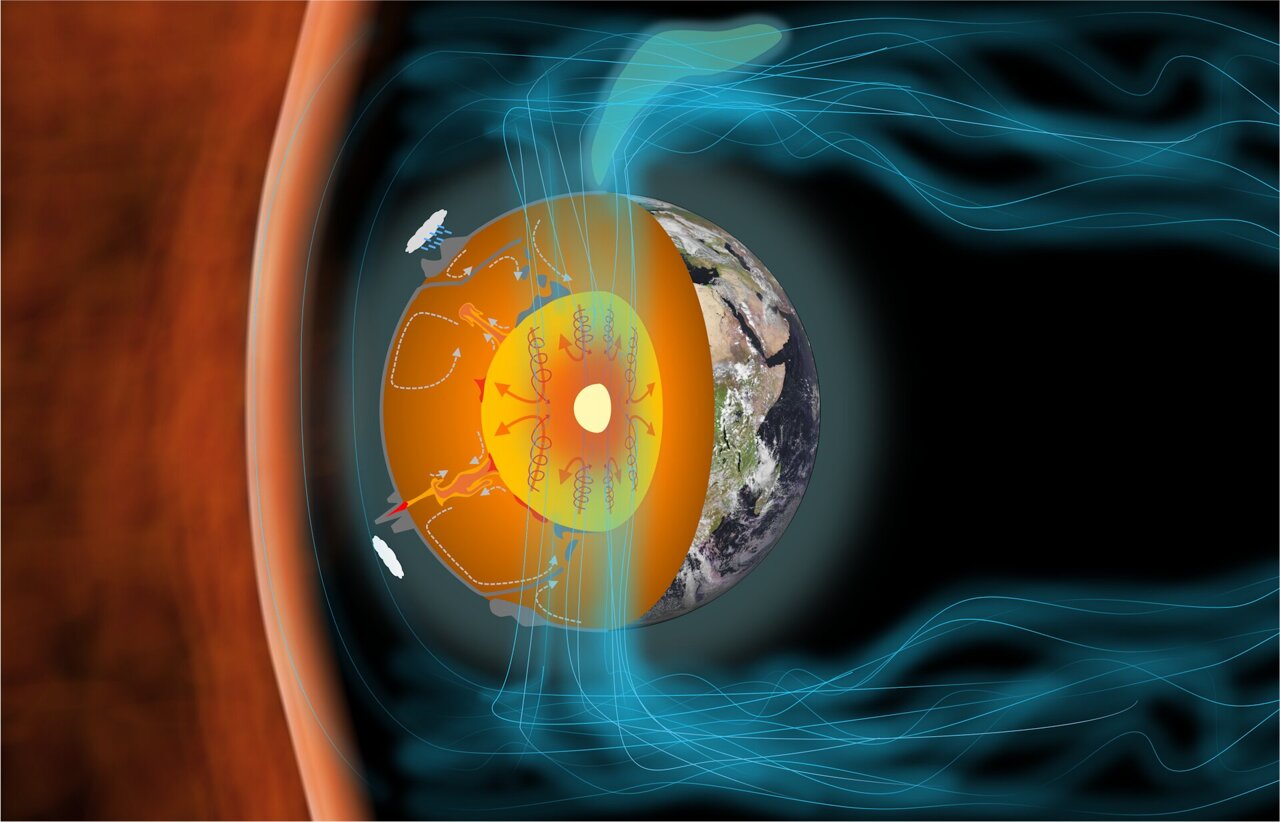
The Earth's Core: A Mysterious Center of Our Planet
The Earth’s core, rich in iron, has played a vital role in the planet’s evolution. It not only generates the magnetic field that protects our atmosphere and oceans from solar radiation but also influences plate tectonics, which have continuously reshaped the continents over time.
Despite its importance, many fundamental properties of the core remain unknown. Scientists are still uncertain about its exact temperature, composition, and when it began to freeze. However, recent discoveries by researchers bring us closer to answering these mysteries.
Understanding the Core's Temperature and Structure
We know that the temperature of Earth's inner core is roughly around 5,000 Kelvin (4,727°C). Initially, it was liquid but has cooled and solidified over time, expanding outward in the process. As it cools, it releases heat into the surrounding mantle, driving the currents responsible for plate tectonics.
This cooling also contributes to the generation of Earth's magnetic field. Today, most of the energy that powers the magnetic field comes from the freezing of the liquid part of the core and the growth of the solid inner core at its center.
However, since we cannot directly access the core, scientists rely on estimates to understand its properties. One key aspect is determining the melting temperature of the core. We know where the boundary between the solid inner core and the liquid outer core lies, as determined by seismology. At this boundary, the temperature must equal the melting temperature because this is where the core is freezing.
Unraveling the Core's Chemistry
Traditionally, two main methods are used to determine the core's composition: meteorites and seismology. By studying meteorites—pieces of planets or destroyed Earth-like planets—we gain an idea of what the core might be made of. These studies suggest that the core is primarily composed of iron and nickel, with possibly a few percent of silicon or sulfur.
Seismology provides more specific insights. When earthquake waves travel through the planet, their speed changes depending on the materials they pass through. By comparing the travel times of these waves with how fast they move through minerals and metals in experiments, scientists can infer the composition of the Earth's interior.
Seismological data indicates that the core is about 10% less dense than pure iron, and the liquid outer core is denser than the solid inner core. Only certain combinations of elements can explain these properties. However, even among possible constituents, the melting temperatures vary significantly, making it difficult to determine the precise properties of the core.
New Insights Through Mineral Physics
In recent research, scientists have used mineral physics to explore how the core might have first begun to freeze. This approach offers a more detailed understanding of the core's chemistry than traditional methods.
Studies simulating how atoms in liquid metals form solids have revealed that some alloys require more intense "supercooling" than others. Supercooling occurs when a liquid is cooled below its melting temperature. The more supercooled a liquid is, the faster it freezes. For example, a water bottle in a freezer can be supercooled to -5°C for hours before freezing, while hail forms quickly when water droplets are cooled to -30°C in clouds.
By examining all possible melting temperatures of the core, researchers found that the most supercooled the core could have been is around 420°C below the melting temperature. Any more than this would result in an inner core larger than what seismology observes. Pure iron would require an impossible ~1000°C of supercooling to freeze, which would cause the entire core to freeze, contradicting seismic observations.
Adding silicon and sulfur, both suggested by meteorites and seismology, worsens the problem, requiring even more supercooling. However, introducing carbon into the mix changes things. If 2.4% of the core's mass was carbon, around 420°C of supercooling would be needed to begin freezing the inner core. This is the first time that such a scenario has been shown to be possible. If the carbon content was 3.8%, only 266°C of supercooling would be required, which is more plausible.
Implications for the Core's Composition
These findings show that while seismology narrows down the possible chemistry of the core, many combinations cannot explain the existence of the solid inner core. The core cannot be made solely of iron and carbon because the seismic properties of the core require at least one additional element.
Research suggests the core is likely to contain a small amount of oxygen and possibly silicon as well. This discovery marks a significant step forward in understanding the core's composition, how it began to freeze, and how it has shaped the planet from the inside out.

Post a Comment for "Earth's Inner Core: Unlocking the Mystery of Its Composition"
Post a Comment