How Fast Do Aircraft Carriers Go? The Fastest in the World
Understanding the Speed of Aircraft Carriers
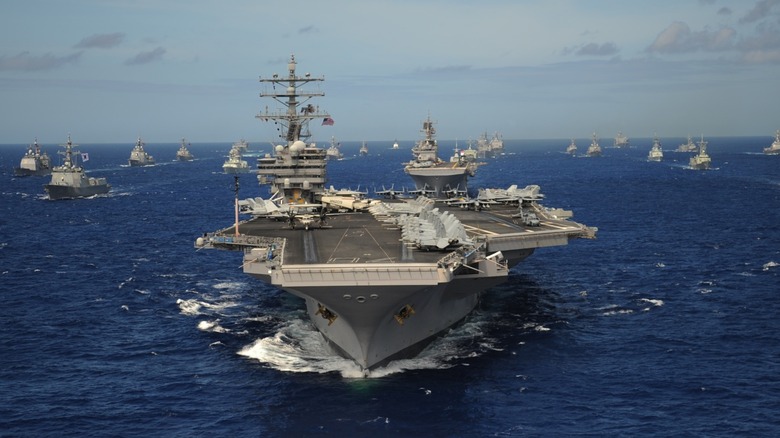
Aircraft carriers are often regarded as the pinnacle of naval technology, serving as the backbone of any fleet's offensive capabilities. These massive vessels are designed to operate at high speeds, allowing them to quickly deploy to strategic locations and maintain operational flexibility. However, the exact speed of these ships remains a subject of speculation due to the secrecy surrounding military specifications.
Most navies do not publicly disclose the technical details of their aircraft carriers, which makes it challenging to determine precise top speeds. Even the United States, known for its transparency in other military technologies, does not provide exact figures for its carrier speeds. Instead, official documents typically state that these ships can exceed 30 knots. For instance, the USS Nimitz, the oldest American carrier still in service, is rumored to reach 31.5 knots, or about 36 miles per hour, though this has never been officially confirmed. Similarly, the USS Gerald R. Ford, considered the most advanced carrier globally, is only listed as capable of more than 30 knots.
China, with the second-largest carrier fleet in the world, also keeps its carrier speeds under wraps. The country currently operates two carriers, with the upcoming Fujian expected to bring the total to three. While the Philippine government estimates that the Shandong can achieve 31 knots, and the Indian Defence Review suggests a 32-knot top speed for the Liaoning, these figures remain unverified. The Fujian is still undergoing testing, so its exact speed is unknown, but it is anticipated to join the fleet soon.
Speeds of Other Nations' Carriers
India operates two aircraft carriers: the INS Vikramaditya and the INS Vikrant. The Vikramaditya, originally a Soviet ship acquired in 2004, was commissioned into the Indian Navy in 2013 and has a reported top speed of 30 knots after engine upgrades in 2014. The Vikrant, India’s first domestically built carrier, has a slightly slower top speed of 28 knots.
The United Kingdom maintains two carriers, the Queen Elizabeth and the Prince of Wales, both of which have a published top speed of 25 knots. This makes them slower compared to China's fleet. France, Italy, and Russia each operate a single carrier. The French Charles de Gaulle, the only nuclear-powered carrier outside the U.S., is reported to reach 27 knots. Italy's Cavour, which replaced the Giuseppe Garibaldi in 2024, can sustain a speed of 27 knots. Russia's Admiral Kuznetsov is noted for a top speed of 29 knots.
The Ongoing Race for Speed
While the U.S. and China are currently leading in terms of carrier speed, India is close behind with the INS Vikramaditya. However, the true top speeds of these vessels remain shrouded in secrecy due to their strategic importance. As new carriers like the Fujian come online, the competition for speed and technological superiority will likely continue to evolve.
For those interested in staying updated on the latest developments in military technology and other related fields, subscribing to newsletters and following industry updates can provide valuable insights. The race for the fastest aircraft carriers is an ongoing story, shaped by innovation, strategy, and the ever-changing landscape of global defense.

Post a Comment for "How Fast Do Aircraft Carriers Go? The Fastest in the World"
Post a Comment