Asheville I-26 Committee Deems Patton Avenue Bridge Essential, Proposes Vibrant LED Lights
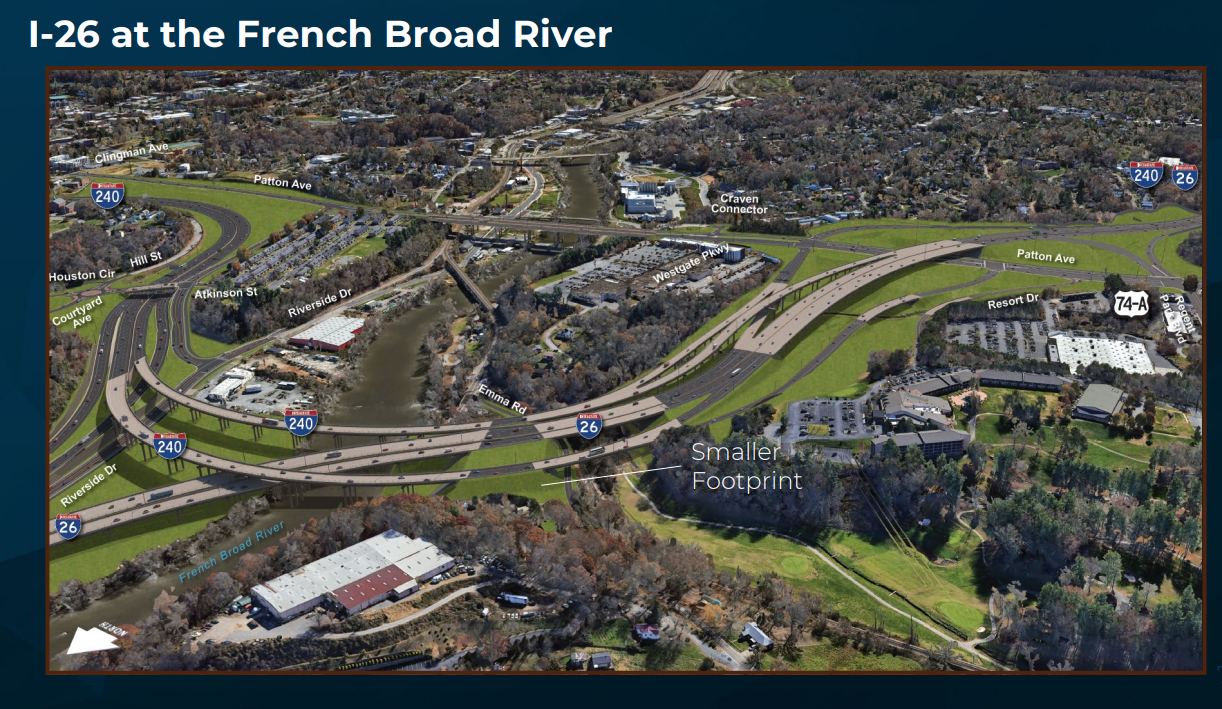
Final Report on the I-26 Connector Project Adjustments
Following a major change to the Interstate 26 Connector project that was unveiled in January, the city of Asheville's I-26 Connector Aesthetics Committee has finalized its report on the modifications. While the North Carolina Department of Transportation (NCDOT) will cover some expenses for new lighting and noise mitigation features on the bridge, the city will be responsible for additional greenway space and landscaping related to the bridge’s aesthetics.
The aesthetics report serves as the committee’s final input to the City Council. It comes after the connector project incorporated a "flyover bridge" spanning four lanes of Patton Avenue. Transportation advocates had previously believed this bridge proposal was no longer viable after NCDOT decided to eliminate it in 2010, opting instead for a tunnel beneath Patton Avenue.
The I-26 project aims to create a median-divided freeway accessible only through interchanges, connecting I-26 in southwest Asheville to U.S. 19/23/70 in northwest Asheville. However, after the initial $1.1 billion contract for the connector was awarded in mid-2024—the most expensive contract in NCDOT history—a presentation to City Council in January revealed that the 150-foot-wide bridge across Patton Avenue had been reinstated.
NCDOT claims this proposal will lead to significant cost savings, but the newly formed I-26 Citizens Coalition opposes the decision, arguing that the bridge poses safety risks for pedestrians and could hinder development. A petition against the bridge plan has already gathered over 2,100 signatures.
During the City Council meeting on September 9, Ted Figura, chair of the I-26 Aesthetics Committee, described the bridge change as something “not anyone wanted” but “necessary.” The committee held seven meetings after the bridge plan was announced.
“The aesthetics committee was called together to recommend ways to soften the impact of this bridge on the community and make the best of the situation,” Figura said. Some adjustments, including noise mitigation and decorative lighting conduits, will not cost the city anything, according to the committee’s report. Photos of the proposed decorative elements show examples of other under-bridge projects featuring dynamic, rainbow-patterned LED lighting.
Other enhancements will be funded by the city after the connector project is completed or through cost-saving design measures during the project’s development. Specifically, a plan to expand the Smith Mill Greenway—starting near the Falconhurst Preserve and running parallel to Patton Avenue across the Jeff Bowen Bridge—will cost $277,000. This expansion will increase the greenway’s width to 18 feet. Another aesthetic adjustment, a pattern inspired by Asheville City Hall, will cost $74,100. Both of these improvements are expected to be funded by cost-saving measures made during the project’s development on the east side of the Jeff Bowen Bridge.
The project’s landscaping budget, estimated at roughly $75,000 annually, will cover planters along the bridge and additional noise reduction efforts. The bridge surfaces will remain plain to allow for public art installations on the south side walls, abutment wall underneath the bridge, and support columns.
City Council member Kim Roney expressed concerns about how the city can reactivate road areas affected by the new bridge. Figura suggested forming a working group to explore opportunities for activating spaces under and near the bridge within the next 12 to 18 months.
The bridge plan is also subject to an April public meeting, the first such event since 2018. At that time, a reevaluated report analyzing the bridge plan’s compliance with the National Environmental Policy Act (NEPA) was expected to be released in the summer of 2025. However, this deadline has now been moved to the end of the year, according to NCDOT spokesperson Stephanie Johnson.
Urban planner Joe Minicozzi, who has been involved in the highway’s development for years, has urged NCDOT to reconsider the bridge proposal. He noted that the citizen coalition is still waiting for the NEPA reevaluation to proceed.
I-26 Connector Project Timeline
As of now, the timeline for the I-26 Connector Project is as follows:
- Initial Contract Award: Mid-2024
- Bridge Plan Reinstatement: January 2024
- Public Meeting: April (first since 2018)
- NEPA Reevaluation Deadline: End of 2024 (previously summer 2025)
For more information about the project, visit ncdot.gov/projects/asheville-i-26-connector.

Post a Comment for "Asheville I-26 Committee Deems Patton Avenue Bridge Essential, Proposes Vibrant LED Lights"
Post a Comment