Self-Healing Ancient Roman Concrete Discovered in Pompeii
The Secret Behind the Longevity of Roman Concrete
For centuries, scholars believed they had a clear understanding of how the Romans created their concrete. However, recent discoveries have revealed that the traditional interpretation may only tell part of the story. New research on an unfinished construction site in Pompeii has uncovered a technique that differs from what was previously thought to be standard practice, offering insights into the remarkable durability of Roman structures.
How Roman Concrete Really Worked
Roman engineer Vitruvius described the production of concrete in his architectural treatise “De Architectura,” written in the first century BCE. For generations, scholars interpreted his instructions as suggesting that limestone should be burned to create quicklime, which would then be carefully hydrated with water to produce slaked lime before being mixed with volcanic ash and aggregate. This method seemed logical—slaked lime is easier to work with and doesn’t generate the intense heat reactions that quicklime does when it comes into contact with water.
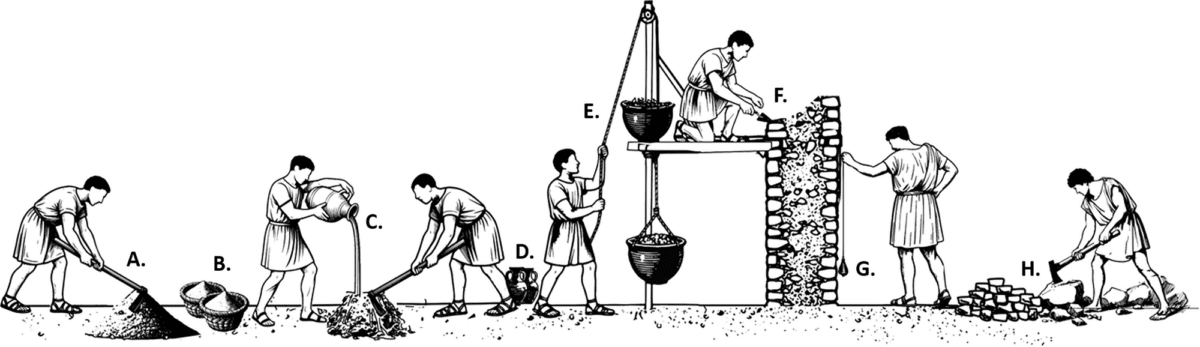
However, new findings from a construction site in Pompeii, buried by Mount Vesuvius in 79 CE, challenge this long-held belief. Researchers from MIT and the Pompeii Archaeological Park analyzed materials from this site and found something unexpected: piles of dry, unmixed materials containing large granules of quicklime (not slaked lime) already combined with volcanic ash. This suggests that the Romans were mixing the ingredients dry, then adding water only when ready to build.
When water was introduced, the chemical reaction was dramatic, with temperatures sometimes exceeding 200°C in localized hot spots. This process created different material properties than the room-temperature mixing that historians had assumed was standard.
The Chemistry Behind Self-Healing Roman Concrete
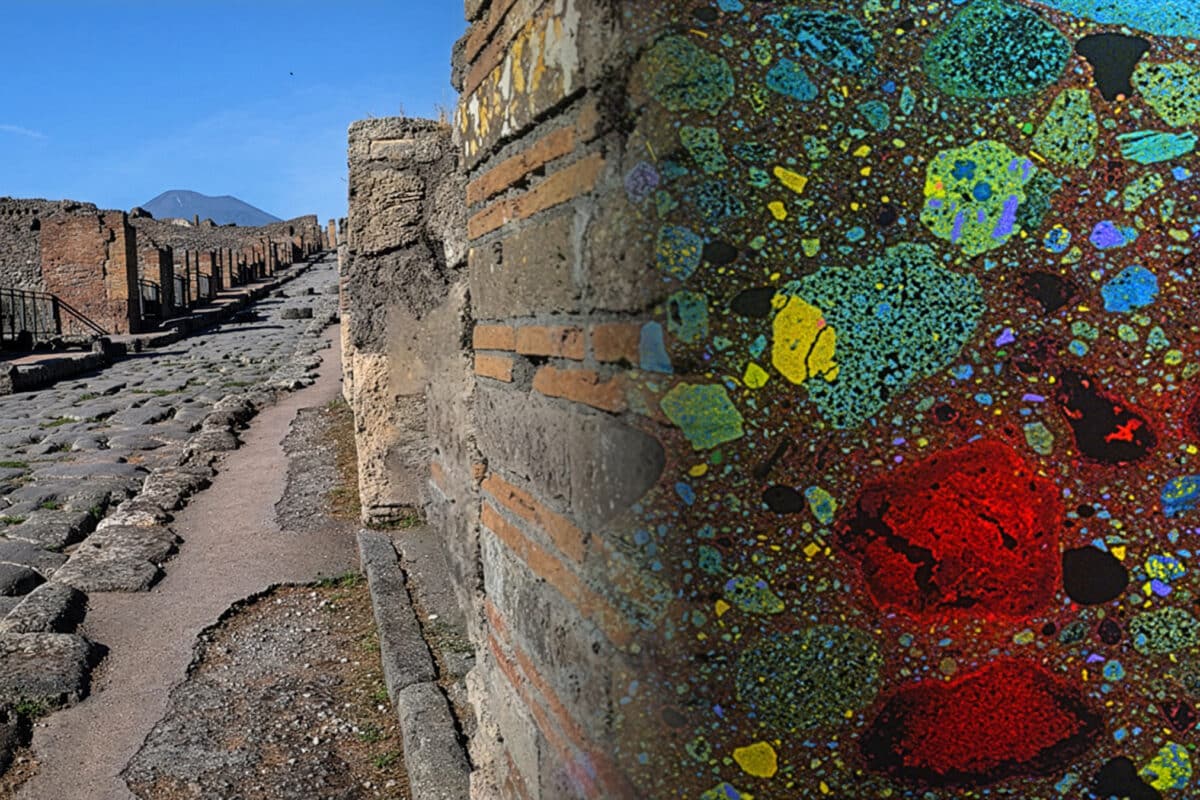
The study, published in Nature Communications, found that the intense heat from quicklime hydration prevented complete dissolution of the lime particles. Instead of forming a uniform paste, the rapid reaction left behind white lime clasts scattered throughout the concrete matrix. These inclusions show distinctive internal cracking and high porosity—microstructural signatures that form specifically during the violent quicklime-water reaction.
Those partially unreacted lime clasts remained chemically active, containing calcium-rich cores that could still dissolve under the right conditions. When cracks formed in the concrete and water seeped in, it slowly dissolved these calcium sources. The released calcium ions migrated through the crack network and reacted with the volcanic materials in the concrete, forming new binding minerals and calcium carbonate that filled tiny cracks.
The researchers documented this repair process by examining the microscopic boundaries between volcanic pumice fragments and the concrete binder. Using electron microscopy and chemical mapping, they found reaction rims where calcium had diffused from dissolved lime clasts into the porous volcanic glass. New minerals had crystallized in these zones, including both calcite and aragonite (different structural forms of calcium carbonate) along with amorphous binding phases. Some pumice vesicles that had been empty voids were now completely filled with these secondary minerals.
This process reduced porosity by filling microcracks and voids, which improved resistance to water intrusion and prevented the progressive deterioration that afflicts modern concrete.
Multiple Scientific Methods Confirm Quicklime Use
Multiple analytical techniques, including infrared spectroscopy, isotope analysis, and electron microscopy, pointed to quicklime in the structural mortars, while some finish layers matched slaked lime signatures.
Infrared spectroscopy revealed the molecular structure of carbonates in the lime clasts. When the researchers ground the ancient lime into progressively finer powders, the changing pattern of molecular vibrations matched the signature of modern quicklime that had carbonated under low-moisture conditions, not the pattern produced by slaked lime.
Isotope analysis provided another line of evidence. The ratio of carbon-13 to carbon-12 and oxygen-18 to oxygen-16 in the lime clasts showed patterns consistent with quicklime rapidly absorbing carbon dioxide from air in a hot, water-limited environment. Materials made with slaked lime produced different isotopic fingerprints, reflecting slower carbonation in the presence of abundant water.
The team compared ancient samples from walls in various stages of completion with the unused dry material piles and with modern reference samples made using both quicklime and slaked lime. The ancient samples grouped consistently with the quicklime references across multiple analytical techniques, while samples from lime-containing amphorae found elsewhere in the structure matched the slaked lime signature.
Romans Adapted Their Concrete Recipe to Different Needs
The evidence suggests that Roman builders weren’t following a single rigid formula. The structural concrete used quicklime and hot mixing, but some finishing mortars showed chemical signatures of added slaked lime. Those lime-filled broken amphorae scattered around the site probably supplied slaked lime for decorative plasterwork and surface repairs that required different working properties than structural concrete.
This adaptive approach makes engineering sense. Hot mixing produces a durable, self-healing material ideal for load-bearing walls, but it sets quickly and generates heat that would damage delicate decorative surfaces. Slaked lime provides better workability for detailed finishing work.
The systematic organization at the construction site reveals sophisticated logistics. Workers prepared large dry batches of quicklime mixed with volcanic ash, stored in specific rooms, ready to be combined with water as needed. This eliminated the need for large slaking pits where quicklime would be slowly converted to slaked lime—structures that ancient texts describe but that archaeologists rarely find.
Why Historical Sources Described One Method While Pompeii Shows Another
Vitruvius wrote “ea erit extincta” when describing lime preparation, which translates to “the lime is extinguished.” Scholars have consistently interpreted “extincta” as referring to slaked lime, and extended this interpretation to mean that slaking was a universal first step. The physical evidence now demonstrates that Vitruvius described one approach while Pompeii shows another method in active use.
Several factors likely contributed to this gap. Vitruvius was describing practices from the late Republic, and techniques may have evolved by the time of the Pompeii construction in 79 CE. Additionally, Vitruvius may have been describing one approach among several, or discussing preparation for specific applications rather than prescribing universal methods. Ancient technical texts often described ideal or traditional practices rather than documenting the full range of techniques actually in use.
The rarity of well-preserved construction sites has also limited understanding. Most archaeological evidence comes from finished structures where the construction process must be inferred from the final product. The Pompeii site is unusual because the eruption of Mount Vesuvius froze an active workplace in time, preserving not just buildings but also raw materials, tools, and structures in various stages of completion.
Modern Concrete Versus Ancient Roman Concrete Durability
The durability gap between ancient and modern concrete is considerable. Conventional concrete typically requires major repairs or replacement within 50 to 100 years. Marine structures face particularly harsh conditions, with seawater and freeze-thaw cycles accelerating deterioration. Roman concrete in similar marine environments has survived for over 2,000 years, and structures like the Pantheon’s massive unreinforced dome remain structurally sound after nearly two millennia.
Modern concrete relies on steel reinforcement for tensile strength, but that steel corrodes over time, causing concrete to crack and spall. Roman concrete contained no steel, yet achieved structural stability through careful material selection and the self-healing properties built into the quicklime-based formulation.
Roman concrete used high-temperature kilns to produce quicklime, similar to modern cement production, so manufacturing emissions were likely comparable. However, the exceptional longevity of Roman structures meant they didn’t need to be repeatedly demolished and rebuilt—an important sustainability advantage over time.
Several research teams are working on Roman-inspired concrete formulations, but adapting ancient techniques to modern requirements presents challenges. Construction standards demand predictable strength development and specific working times. The reactive lime clasts that enable self-healing must be carefully balanced to provide long-term benefits without compromising short-term performance.

Post a Comment for "Self-Healing Ancient Roman Concrete Discovered in Pompeii"
Post a Comment