The State of AI: Llama's Rise, AI Travel Planning Surges, Growing Concerns Escalate
Understanding AI Usage in the United States
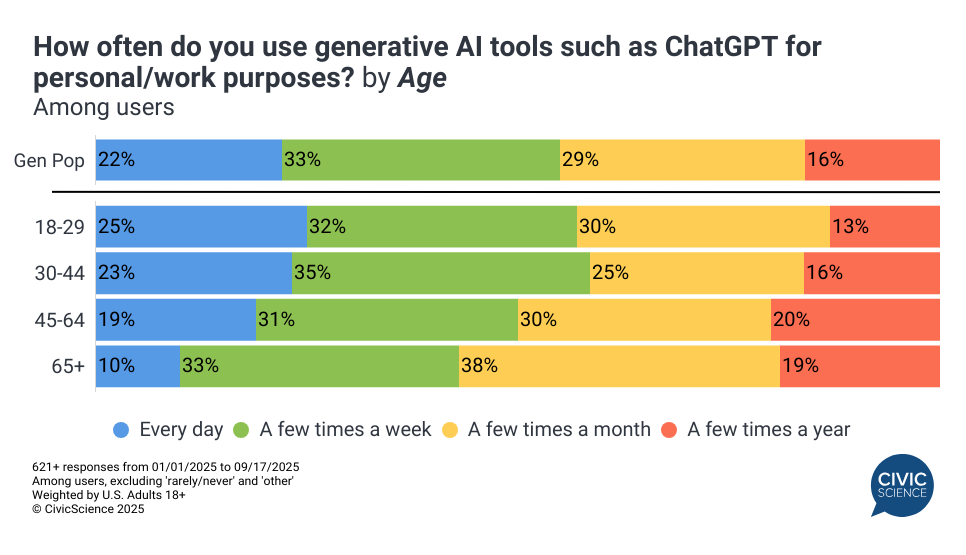
Generative Artificial Intelligence (AI) has become a significant part of daily life for many Americans. Recent data reveals that 18% of U.S. adults use AI tools every day, while another 33% use them a few times per week for personal or professional purposes. Despite this widespread usage, not everyone is fully on board with the technology. The integration of AI into everyday routines raises important questions about how Americans are engaging with it and what concerns they have.
Who Is Using AI?
Women are more likely than men to use generative AI tools daily, with a six percentage point difference. Gen Z leads as the most frequent daily users, but they only outpace Millennials by two percentage points. Gen X users lag just four percentage points behind Millennials, indicating that AI is not exclusively a young person’s tool. Interestingly, those without a college degree are nearly twice as likely as those with an associate’s or bachelor’s degree to be daily AI users.
Popular AI Tools
When it comes to specific tools, OpenAI/ChatGPT is the most widely used, leading Google Gemini and Microsoft Copilot by six and 13 percentage points respectively. While the usage of these top three tools has remained relatively stable, Meta Llama has seen the most significant growth, increasing by eight percentage points since April. Microsoft Copilot, Anthropic Claude, and Perplexity AI have also experienced positive growth.
Changing Interests in AI
Interest in AI assistance is evolving with the seasons. Personal use, such as entertainment and cooking, remains the top reason for using AI tools. However, travel planning has overtaken work and school-related tasks as the second most common use, showing a 14 percentage point increase since April. Shopping assistance, which remains in third place, has also seen a six percentage point increase over the same period.
This shift away from work and school-related tasks suggests a new wave of interest in AI, particularly as the holiday season approaches. This trend could influence how AI is used in the coming months.
AI Voice Assistants
Search engine result summaries are currently the most helpful use of AI technology in everyday life, followed by language translation and digital assistants/smart home devices. Nearly half of Americans use AI voice assistants like Amazon Alexa and Apple Siri. Although higher-income earners and Gen Z are more likely to use these devices, overall usage has steadily increased since Q3 of 2024.
The perception of AI voice assistants as niche has decreased, dropping to 32% in the third quarter of this year, down from 37% in Q3 2024. This indicates a growing acceptance of AI in daily life.
AI Sentiment and Concerns
As AI becomes more prevalent, concerns about its impact on jobs are increasing. One-quarter of employed U.S. adults are very concerned about how AI will affect their careers. Technical job holders are the most concerned, with 40% expressing hesitation. Business management and service professionals also show similar levels of discomfort, highlighting that AI's impact is felt across various industries.
Beyond job security, general concerns about the proliferation of AI tools are widespread. More than three out of four Americans are at least somewhat concerned about AI. Although there was a slight drop in July and August, sentiment is trending upward again.
The percentage of people who believe AI will have a neutral impact on their quality of life has been decreasing since Q2 of 2025. Meanwhile, those who believe AI will have a positive impact have dropped by four percentage points, while those who think it will have a negative impact have risen by four percentage points. These shifts indicate that AI's growing presence is not bridging the divide in public sentiment.
The Future of AI
As AI continues to integrate into daily life, its impact remains uncertain. While some see potential benefits, others express growing concerns. The long-term effects of AI on society and the economy are still unfolding, and it remains to be seen whether the anticipated outcomes will materialize or if entirely new challenges will arise.
Understanding these trends and concerns can help shape strategies that resonate with consumers in real time. By leveraging insights into shifting mindsets, businesses can better navigate the evolving landscape of AI.

Post a Comment for "The State of AI: Llama's Rise, AI Travel Planning Surges, Growing Concerns Escalate"
Post a Comment